While travelers across Europe today can choose between dozens of airline liveries, the financial reality of 2026 reveals a startling truth: the continent’s aviation landscape has been funneled into an “hourglass” structure. Behind the colorful tail fins and diverse boarding music, three massive corporate entities—Lufthansa Group, International Airlines Group (IAG), and Air France-KLM—now control the vast majority of non-budget seat capacity in European airspace.
The Great European Consolidation
Twenty years ago, Europe was a patchwork of “flag carriers”—national airlines that represented the identity of their home countries. Today, most of those independent names have been absorbed into the “Big Three.”
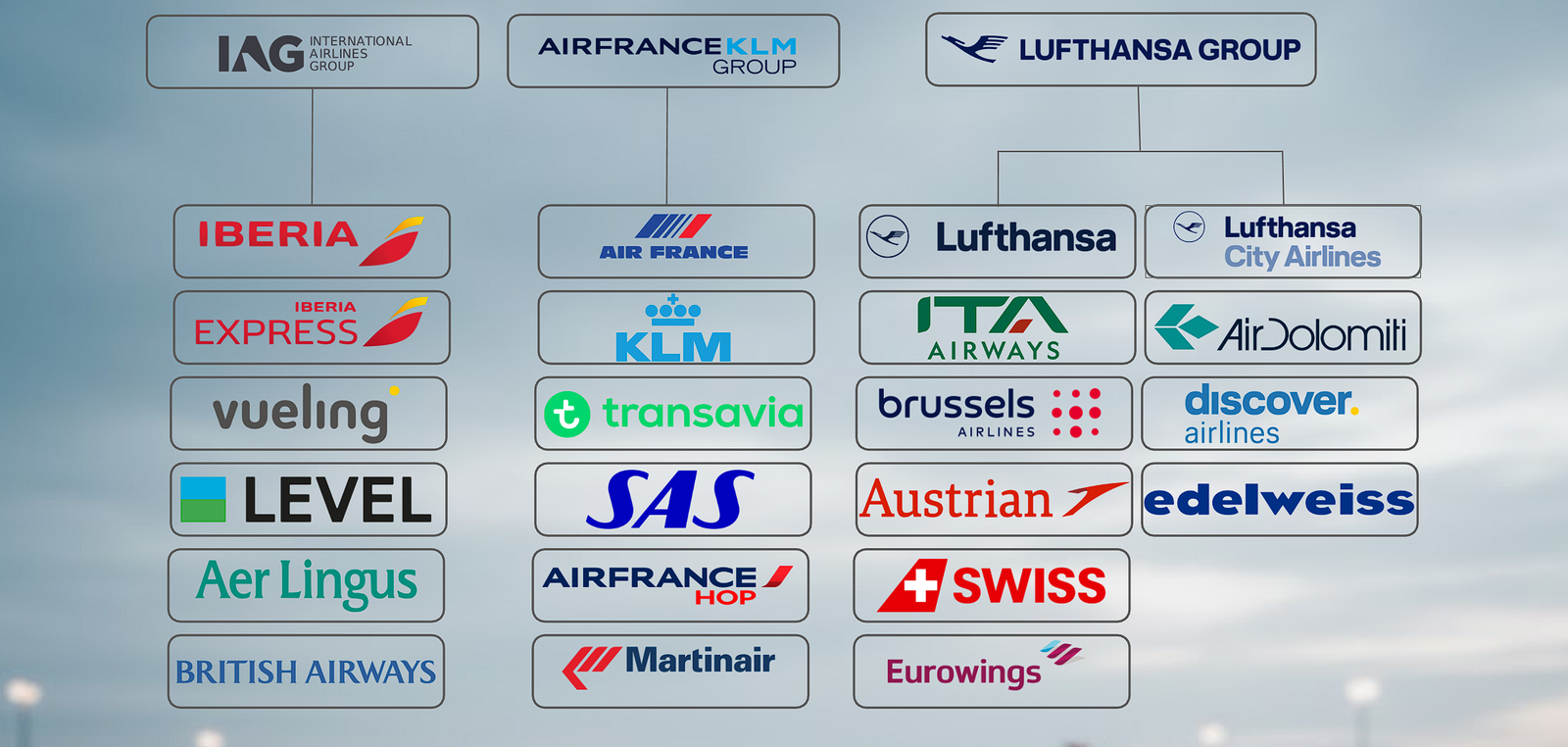
- Lufthansa Group: From its base in Frankfurt, it has built a Central European empire, acquiring Austrian, SWISS, Brussels Airlines, and most recently, Italy’s ITA Airways.
- IAG: The Anglo-Spanish powerhouse formed by the merger of British Airways and Iberia has expanded its reach by absorbing Aer Lingus and the low-cost giant Vueling.
- Air France-KLM: The Franco-Dutch alliance has recently pushed into the Nordic markets, securing a dominant stake in SAS (Scandinavian Airlines) to finalize its grip on the northern corridors.
The “Hourglass” and the Illusion of Choice
The video highlights a phenomenon known as the “Hourglass Effect.” At the top, you have the three parent groups. In the middle, the market narrows through joint ventures and shared booking systems. At the bottom, the passenger is presented with an “illusion of choice.”
For example, a passenger flying from Milan to New York might see options for ITA, Lufthansa, or United. In reality, because ITA is now part of the Lufthansa Group and United is a “metal-neutral” joint venture partner, the pricing, scheduling, and revenue are coordinated. No matter which button you click, the money often flows into the same corporate treasury. This lack of true competition removes the incentive for airlines to lower fares or improve service on “captive” routes.
The Disappearing “Middle Class” of Airlines
The most significant casualty of this consolidation is the “middle-tier” airline. Carriers like Air Berlin, Alitalia, and Virgin America once provided a vital service: they were large enough to compete with the giants but small enough to remain nimble and price-competitive.
As these middle-tier airlines were bought out or driven into bankruptcy, the market split into two extremes:
- The Ultra-Low-Cost Carriers (ULCCs): Like Ryanair and Wizz Air, which offer “no-frills” transport.
- The Premium Groups: The Big Three, which focus on high-yield business travel and hub-and-spoke connectivity.
The “middle” has vanished, leaving passengers with a binary choice: pay for a budget seat with hidden fees, or pay a premium to one of the three major blocks.
Slot Dominance: The Invisible Moat
In Europe, the power of these groups isn’t just in their fleets, but in their landing slots. Major hubs like London Heathrow, Paris Charles de Gaulle, and Frankfurt are at maximum capacity. Because slots are often “grandfathered” to the historical occupants, the Big Three effectively own the “real estate” of the sky. A new airline cannot simply decide to fly to Heathrow; they must buy a slot, which can cost tens of millions of euros, effectively preventing new competition from ever entering the market.
The Regulatory Backlash
As we move through 2026, European regulators (DG COMP) have become increasingly wary. Recent rulings have forced these groups to divest slots to smaller rivals as a condition for mergers. However, for many regional travelers, the damage is done. Over 400 regional routes across Europe have been “rationalized” or cut entirely since 2019 as the Big Three prioritize their most profitable long-haul hubs.
About the Author